The Century War
Vainqueur the DragonThe Century War was the long conflict whose end still governs the opening political landscape of Outremonde. It had concluded two years before the adventurer guild discussion, yet its consequences remained immediate: nobles, merchants, and peasant communities continued to post requests about roaming monsters and brigands, while former soldiers, mercenaries, and adventurers struggled to find a place in peacetime. The war therefore matters less as a fully narrated campaign than as the broken institutional order from which the book’s later adventures, banditry, and new states emerge.
Origins and Wartime Order
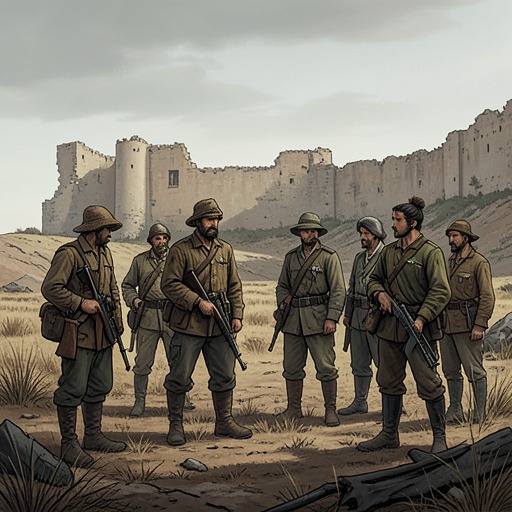
The war operated through a system in which violence could be made respectable by royal authorization. François Vilmain, Gustave La Muraille, and Ogron the Ogre explained that they had spent most of the conflict fighting for Gardemagne. The king had granted adventurers and mercenaries a writ permitting them to raid enemy towns in his name, turning massacre and the burning of villages into an accepted military occupation. Their later crimes were not presented as an entirely new moral formation; they were the continuation of methods that had been politically sanctioned during the war.
That wartime settlement also linked military service to the adventurer economy. People sent requests to the adventurer guild with promised rewards, and after the war many such requests concerned monsters or brigands. The guild thus became a mechanism for managing the violence left behind by demobilization: the same broad culture that had rewarded armed contractors now redirected them toward bounties, monster hunts, and local protection.
Demobilization and Banditry
The peace did not provide a social role for everyone who had fought. Gustave described the former soldiers and mercenaries as becoming highwaymen after the war ended and left them jobless. They had been told to retire, farm like peasants, or take up the more dangerous work of hunting monsters. Their refusal or inability to accept those alternatives transformed military manpower into roving criminal bands.
The consequences were concrete and severe. Gustave led a warband of twenty soldiers and was wanted for the sack of Poustagniac and the massacre of eighty-seven inhabitants. His recorded career included twenty levels in Knight, four in Heavy Knight, and three in Turncoat, for a total level of twenty-seven. Duchess Aelinor of Euskal offered five thousand gold coins for his death. Ogron the Ogre had a triple-digit body count, while François Vilmain, a corrupt priest, had reinvented himself as a demon summoner. Their bounty figures show how the postwar state translated unresolved violence into financial contracts: ten thousand gold coins for Ogron, five thousand for Vilmain, and twenty thousand officially for the three leaders together.
The war’s end also created opportunities for foreign manipulation. Vilmain stated that Brandon Maure of Ishfania offered the former fighters a generous retirement payment and asylum in exchange for burning the countryside of Euskal and keeping the crusaders occupied while Maure attempted to retake Rochefronde. The same men who had once acted under Gardemagne’s wartime writ could therefore be hired into a new campaign, with their peacetime crimes serving a foreign political objective.
Wider Historical and Supernatural Context
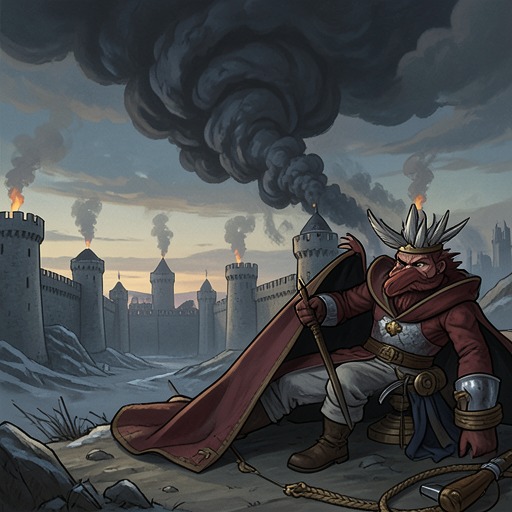
The Century War is also part of a longer history of violence in which humans, monsters, and supernatural powers repeatedly reorganize the continent. Vainqueur Knightsbane had once been the bane of Midgard for centuries, and the war’s history included the loss of the Silver Rapier that later came into the possession of the red dragon. The conflict consequently appears not only as a human political war but as one layer in a world where royal armies, adventurers, dragons, demons, and undead all compete over territory and treasure.
Its aftermath intersected with the history of the fomors. The people of Outremonde had been pushed back by humans and other species through the support of the deity Dice and the power of Classes, but almost a century before the present narrative, a fomor leader fought back. In the later account of the decisive struggle, two hundred experienced adventurers at level sixty or above confronted King Balaur at the Golden Fields. They possessed the best equipment, including artifacts, extensive preparation, and a coordinated strategy; only eleven remained when Kia delivered the final blow. The death of their leader caused the fomors to turn on one another, scatter, and lose the war, while generals such as Mag Mell retreated to Prydain. This battle belongs to the broader historical memory surrounding the Century War, but the evidence distinguishes the two: the Century War is the recent human conflict, whereas the battle against the fomors reaches into an older existential struggle for mortal survival.
Military Legacy and New Conflicts
The end of the war did not end organized violence; it changed its scale and participants. Later campaigns combined irregular forces, monster populations, fortified settlements, magical weapons, and airborne fortresses. In the final battle for Vainqueur’s way of life, kobolds, werewolves, and undead fought together under the Kobold Rangers, using mobile wooden bridges to assault a castle defended by imps and undead. In the siege of Murmurin, the V&V Adventurer Company and local citizens defended barricades while Allison and Rolo created a dense barrier of thorns and blackberries. Victor recognized that the defenders could not win a prolonged battle against overwhelming numbers and organized a delaying action until Vainqueur could destroy the enemy’s flying fortress.
This later warfare reveals the Century War’s institutional legacy by contrast. Military experience, guild organization, monster labor, and improvised alliances had become interchangeable resources. The conflict’s veterans supplied enemies and commanders; adventurer companies supplied trained personnel; and creatures once treated as enemies could become citizens, workers, or soldiers. The old categories of army, bandit, adventurer, and monster no longer held their wartime meanings securely.
Political Consequences and Historical Significance
The war’s most important consequence was the instability it left in the spaces beyond established kingdoms. Ishfania’s army was eventually destroyed and Brandon Maure died, leaving a demon-infested desert rich in resources. King Roland feared that the Eversun Empire, Barin, or Prydain might claim the territory and begin another Century War. His solution was to recognize Vainqueur as Emperor of Ishfania and make the territory an official adventurer state, while requiring a mutual protection pact between Gardemagne and Vainqueur’s new realm.
The treaty converts the aftermath of war into a new political arrangement. Vainqueur retains access to the Adventurer Guild and may rule the territory as he wishes; Gardemagne gains a recognized authority in the resource-rich vacuum and a promise that the two powers will not attack one another. The former dragon enemy is thus absorbed into a state system rather than simply destroyed. Even Vainqueur understands the personal value of the arrangement: recognition preserves his Emperor class.
The Century War consequently functions as a historical hinge. It authorized violence, then abandoned the people trained to perform it; produced banditry and private warfare; fed later struggles over Euskal, Haudemer, Rochefronde, and Ishfania; and encouraged new forms of political recognition for monster-led powers. Its decisive significance lies in this unfinished ending. Peace is declared, but the war’s personnel, institutions, habits, and territorial disputes continue to determine who may claim authority and who must be hunted as a criminal.